
Fintech marketing looks like regular performance marketing until you try to run it. Then you quickly discover that finance is a different category entirely, and the standard playbook breaks in ways that cost real money.
Why Fintech Marketing Is Harder Than Most Verticals
Financial products sit at the intersection of high stakes and low trust. When someone is deciding whether to put their money into an app, savings product, or lending platform, the psychological friction is significantly higher than when they’re buying a pair of trainers. The cost of being wrong is financial loss, potential fraud, or regulatory trouble. Prospects know this, and it shows in their conversion behaviour.
I spent nearly 4 years in fintech performance marketing, first at Renmoney and then as Performance Marketing Lead at OhentPay. The patterns I observed consistently were: higher CPCs than comparable non-finance products, longer consideration cycles, extreme sensitivity to trust signals, and a constant battle with ad platform policies.
Challenge 1: Ad Platform Restrictions
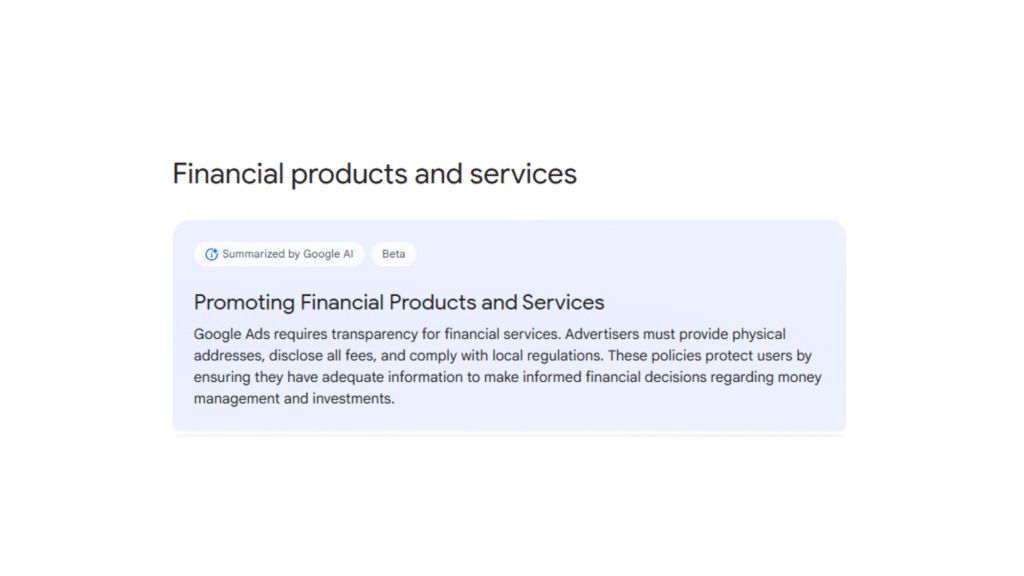
Meta, Google, and most programmatic platforms have strict policies around financial products. You can’t make specific return claims without regulatory disclosure. Certain audiences are restricted from credit products under fair lending rules. Ad copy that sounds promotional for financial services triggers extra review cycles and higher rejection rates.
The practical implication: your ad copy needs to be both compelling and compliant simultaneously. The most effective approach I’ve found is to lead with the problem your customer has (e.g., ‘Waiting weeks for a salary advance?’) rather than the product claim (e.g., ‘Get instant loans at low rates’). Problem-first framing tends to clear platform review faster and connects more authentically with real customer pain points. You can also whitelist your ad account and add necessary terms and conditions to the footer of your landing page.
Compliance tip: Work with your legal and compliance team to create a pre-approved library of ad copy and creative. This speeds up production significantly and reduces the risk of campaigns going down mid-flight.
Challenge 2: The Trust Gap
Trust is the fundamental conversion barrier in fintech. Especially in African markets where there’s a history of financial fraud and predatory lending, potential customers approach new financial products with scepticism that marketers from Western markets often underestimate.
Building trust through marketing means several things in practice. It means using real customer testimonials, not polished marketing statements, but genuine stories about specific outcomes. It means transparency about fees, rates, and terms in your marketing materials, not buried in the footer. It means regulatory credibility signals: CBN licence numbers, partnership logos with established institutions, and security certifications displayed prominently.
The counterintuitive finding from my campaigns: being more transparent about limitations (e.g., ‘Available to salary earners only’) actually increased conversion rates by pre-qualifying traffic and reducing post-signup churn. Qualified leads who know exactly what they’re getting convert and retain better than broad audiences who were sold a vague promise.
Challenge 3: The Multi-Touch Consideration Cycle
In non-finance categories, you might reasonably expect a customer to see an ad and convert in one session. Fintech rarely works this way. Research by financial services marketers consistently shows that the average customer touches a financial brand 6–8 times before converting. This has major implications for attribution and channel strategy.
Single-channel or last-click attribution will mislead you into cutting the channels that actually drive awareness and consideration, the ones that start the journey, while over-investing in retargeting that’s just capturing the end of a journey you already started. Build a multi-touch attribution model and accept that your top-funnel investment will look inefficient in the short term, but is essential to the bottom-funnel efficiency you’re measuring.
Challenge 4: Regulatory and Seasonal Constraints
Fintech campaigns can go dark overnight due to regulatory changes. I’ve experienced campaigns being paused mid-month due to CBN policy updates that affect lending rates or product eligibility criteria. Building contingency into your marketing calendar, always having a compliant alternative campaign ready to activate, is non-negotiable in this environment.
Similarly, fintech shows strong seasonality that non-finance marketers often miss: salary advance and loan products spike at month-end, savings products see an uptick at the beginning of the year, and credit products often slow during festive periods when disposable income psychology shifts. Aligning your campaign calendar and budget pacing with these patterns can materially improve your cost efficiency.
What Good Fintech Performance Marketing Looks Like
Based on my experience, the most effective fintech marketing programmes share these characteristics: a content layer that educates and builds trust before asking for conversion; a compliance-first creative process that doesn’t slow down production; multi-touch attribution that gives credit across the full journey; audience segmentation that separates acquisition from retention; and a test-and-learn culture that treats every campaign as a data source, not just a revenue event.
Fintech is a hard category. But the marketers who understand its unique dynamics, trust, compliance, multi-touch consideration, and regulatory risk are the ones who build sustainable acquisition systems.
If you’re building or scaling a fintech marketing campaign and want an experienced hand on the strategy, I’d be glad to connect. You can book a Growth Strategy Sprint to start.
