
Local SEO for Service Businesses: A Practical Guide to Ranking in Your Area
If you run a service business and you’re not ranking locally, you’re invisible to the customers who are actively searching for what you offer right now. Local SEO is one of the highest-ROI investments you can make, and most of it is free.
What Local SEO Actually Is
Local SEO is the practice of optimising your online presence so that your business appears in search results when people in your area search for services you offer. This includes showing up in Google’s Map Pack (the three business listings that appear before organic results), ranking in organic search for location-specific keywords, and maintaining accurate business information across the web.
Unlike national SEO, which often requires large budgets and months of content production, local SEO rewards consistency and accuracy over complexity. I’ve helped businesses in Lagos and across dramatically improve their local visibility with relatively modest investments.
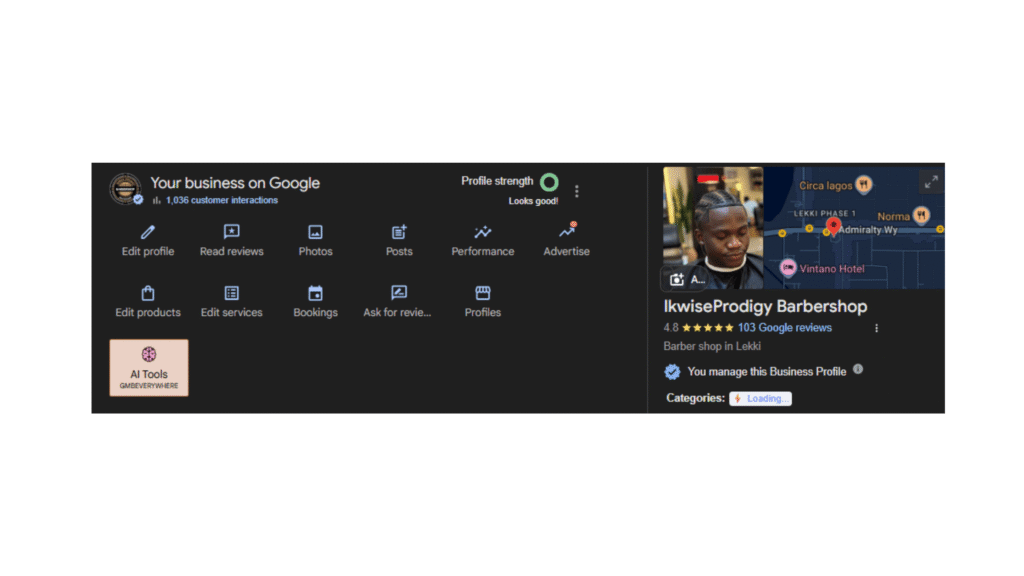
Step 1: Claim and Fully Optimise Your Google Business Profile
Google Business Profile (formerly Google My Business) is the single most important local SEO asset you have. Yet most businesses either haven’t claimed their profile or have left it half-complete. A fully optimised profile can put you in the Map Pack within weeks.
Here’s what a fully optimised profile includes: complete and accurate NAP (name, address, phone number), the correct business category (be specific — ‘Ikwise Prodigy Barbershop’ beats ‘Ikwise Prodigy’), a keyword-rich business description, at least 10 high-quality photos, regular posts (weekly is ideal), and active Q&A management. Most importantly, you need reviews and a strategy to get them consistently.
Key insight: The businesses in the top 3 of Google’s Map Pack almost always have more recent reviews than their competitors, not just more total reviews. Recency signals activity and trust.
Step 2: Build Local Citations
A citation is any mention of your business name, address, and phone number (NAP) on another website. Local directories, industry listings, and chamber of commerce websites are all sources of citations. Consistency is critical; if your address appears slightly differently across different sites (e.g., ‘Victoria Island’ vs ‘V.I.’), it can confuse Google’s understanding of your business and suppress your rankings.
Start with the major directories in your market: for Nigeria, that includes VConnect, BusinessList, and Nairaland business listings, in addition to global platforms like Yelp, Foursquare, and Apple Maps. Submit your consistent NAP to at least 20–30 relevant directories and monitor them for accuracy over time.
Step 3: Optimise Your Website for Local Keywords
Your website needs to clearly signal where you operate and what you do. This means including your city or region in your page titles, meta descriptions, and H1 headings. If you serve multiple areas, create separate location pages (e.g., /marketing-lagos, /marketing-abuja) rather than stuffing all locations into one page.
Your homepage or services page should include the keywords prospects would actually type: ‘Ikwise Prodigy BarberShop Surulere. Use Google’s own search suggestions and the ‘People also ask’ section to identify exactly how your market phrases their searches.
Step 4: Build Local Backlinks
Backlinks, links from other websites to yours, remain one of Google’s strongest ranking signals. For local SEO, the most valuable links come from local sources: local news sites covering your business, sponsorships of local events, partnerships with complementary businesses, and guest posts on locally-relevant publications.
One underrated tactic: offer to write a guest article for a local business association or industry group. You get a high-quality backlink, they get free content, and Google sees your site as a relevant local authority.
Step 5: Generate and Manage Reviews Strategically
Reviews are a direct ranking factor for Google’s local algorithm. But more than rankings, they drive conversions, prospects read reviews before contacting a service business. Build a simple review generation system: after every successful client engagement, send a personalised message thanking them and including a direct link to your Google review page.
Respond to every review, positive and negative. Responding to positive reviews reinforces the relationship and signals to Google that your profile is active. Responding professionally to negative reviews shows potential clients that you take service seriously and handle issues with maturity.
Measuring Your Local SEO Progress
Track your local rankings using free tools like Google Search Console (for organic impressions and clicks) and BrightLocal’s free trial (for Map Pack rankings). Monitor your Google Business Profile Insights monthly, look at how many people viewed your profile, clicked to your website, or called you directly. These numbers should trend upward as your optimisation takes effect.
Consistent effort across these five areas, Google Business Profile, citations, on-page optimisation, local backlinks, and review generation, compounds over time. Most service businesses that implement this properly see meaningful ranking improvements within 60–90 days.
If you’d like a full SEO audit and keyword strategy for your business, check out my Organic Growth & Local Visibility service.